

Tales of a Photon: From the Sun to Your next Breath
My story began some 170,000 years ago, when Earth was a very different world from the one we know today: vast expanses of ice covered northern Europe, enormous mammoths roamed its landscapes, and humans were only beginning to venture beyond Africa. My birthplace is one of the most extreme environments that exists: the center of the Sun. There, at around 15 million degrees and under a pressure 250,000 times greater than that of our atmosphere, hydrogen nuclei collide, overcome the repulsive force that keeps them apart, and fuse together in an incandescent embrace. It is in this nuclear dance that the energy is born which, after countless transformations, will eventually become tiny specks of light like me: photons.

I thought my journey would be a fast one, considering the immense energy I carried with me in the first moments of my existence. But I soon discovered that the interior of the Sun was a labyrinth: I collided again and again with electrons and nuclei, changed direction, was absorbed, and was reborn as another photon. So countless interactions passed while, very slowly, my energy made its way toward the outside. After an extraordinarily long journey, I reached a new frontier where the transport of energy no longer depended mainly on my endless collisions, but on enormous currents of plasma rising and falling, carrying the Sun’s heat with them. Finally, I reached the Sun’s brilliant surface, and there, at last, I found a clear path.

For 8 minutes and 20 seconds, I travelled along a cold, lonely, dark road. At times, I missed the suffocating bustle of my home, but then I saw it. Before me appeared a small blue marble, suspended in the black immensity of space, barely a sphere illuminated by my own light. That blue immediately caught my attention. I had never seen a colour like it. It stretched as far as I could see, surrounding patches of green and ochre that seemed tiny against the vastness of the blue.
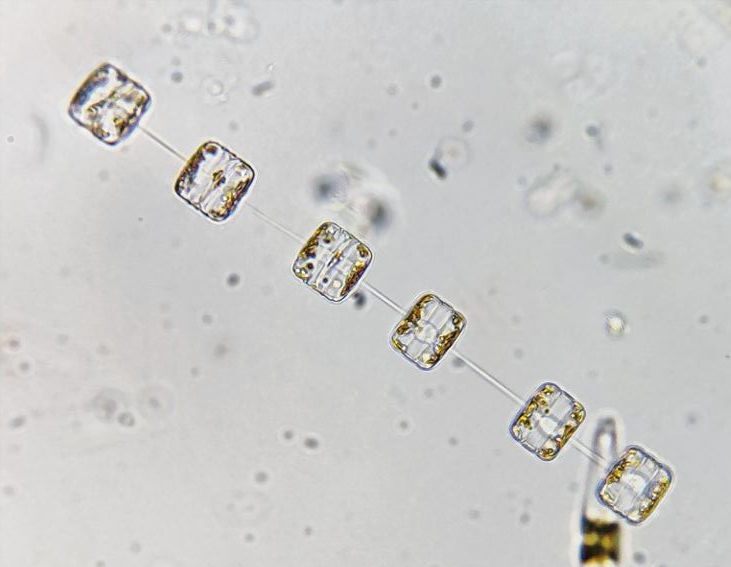
I descended toward that immense ocean and, for the first time since escaping the Sun, my journey changed direction. As I penetrated its waters, tiny creatures were revealed to me, almost invisible to the naked eye, floating by the millions in that liquid world. They were phytoplankton. Without my knowing it, those creatures had been waiting for my arrival. When I finally reached one of them, its pigments wrapped around me, as if they knew about my long journey. In return, I gave them my energy. With it, that tiny creature took in water and carbon dioxide from the ocean and the air, separated their components, and used the carbon to build organic matter: molecules that would become food and part of the bodies of new forms of life. But not everything remained inside it. As a result of this process, it released oxygen into the water and, over time, into the atmosphere. After 170,000 years of making my way from the depths of the Sun, my journey was about to end, but my energy was not: it had now become part of a tiny creature capable of turning light into life. And I understood that this was not the end of my story, but the beginning of another.

I remained silent, watching the data appear on the screen of my Fast Repetition Rate Fluorometer. This small instrument was capable of recording, again and again, the interaction of thousands of these invisible journeys: photons reaching the ocean, being captured by phytoplankton, and delivering their energy to set in motion a chain of transformations that would ultimately produce organic matter and release oxygen. For me, this was just another measurement within my study of primary production in subarctic waters. But the longer I looked at the data, the harder it became to think of them as simply numbers.
Behind every record was a story that had begun in the heart of a star, crossed space and time, descended into those waters, and ultimately been transformed into matter, energy, and oxygen. Billions of these tiny journeys were taking place all around us, invisible to our eyes. And I understood then that what I was measuring as primary production was, in reality, the final stage of a cosmic journey: an immense chain of changes and transformations that, thanks to phytoplankton, makes a decisive contribution to the oxygen that you and I breathe.


Comments