

Concentrating Arctic phytoplankton with reverse filtration
- Ana Narberhaus
- 4 days ago
- 3 min read
Phytoplankton are small but important organisms. They form the foundation of marine food webs and play a crucial role in the global carbon cycle. However, quantifying these tiny organisms is challenging because of their high diversity, sometimes very similar morphology, small size and the difficulty of capturing the whole community with a single method while maintaining a high taxonomic resolution. Fortunately, on this cruise we have several people interested in phytoplankton, each looking at a slightly different part of this fascinating community. Catarina is specifically sampling coccolithophores —a phytoplankton group that produces beautiful shells made of calcite plates called coccoliths—, Jana is sampling microphytoplankton from the surface and Nandi and Lotty are continuously monitoring the community using flow cytometry.
I am interested in looking at the phytoplankton community as a whole and I am also using imaging flow cytometry to do so. The instrument I use, an Amnis ImageStream Mk II Imaging Flow Cytometer, combines flow cytometry with microscopy. It allows me to analyse characteristics such as shape, spatial distributions and intensity of the fluorescence of each cell, while simultaneously capturing brightfield images and extracting related features such as cell length and circularity. However, the instrument is also very sensitive and unfortunately cannot be used directly on board. It also processes only relatively small volumes of liquid. Since I want to capture not only the most abundant species but also the less abundant ones, I need to concentrate the phytoplankton from much larger volumes of seawater before I can analyse them back in the lab. Twice a day, I collect water from the CTD at the deep chlorophyll maximum, the depth with the highest concentration of chlorophyll a. Chlorophyll a is found in photosynthetic organisms and is commonly used as a proxy for phytoplankton biomass. I collect ~30L of seawater at each sampling time.

I first filter this water through a 200µm mesh to remove any larger organisms and debris and then through a 3µm filter to collect any organisms larger than that. To achieve this, I use reverse filtration. Instead of using a pump to filter the water, reverse filtration takes advantage of gravity. I place a 10L canister as high as possible and connect it to the filtration device using tubes and slowly fill the filtration chamber with water. The tricky part here is placing the 3µm filter onto the water, since it easily spills due to the ship movement. Once the filtration is done, the 20-30L of seawater have been reduced to ~45ml. In a final step, I fix the samples with paraformaldehyde (PFA). This preserves the cells so that, once I am back in the lab, I can analyse the phytoplankton community as close to the original state as possible.
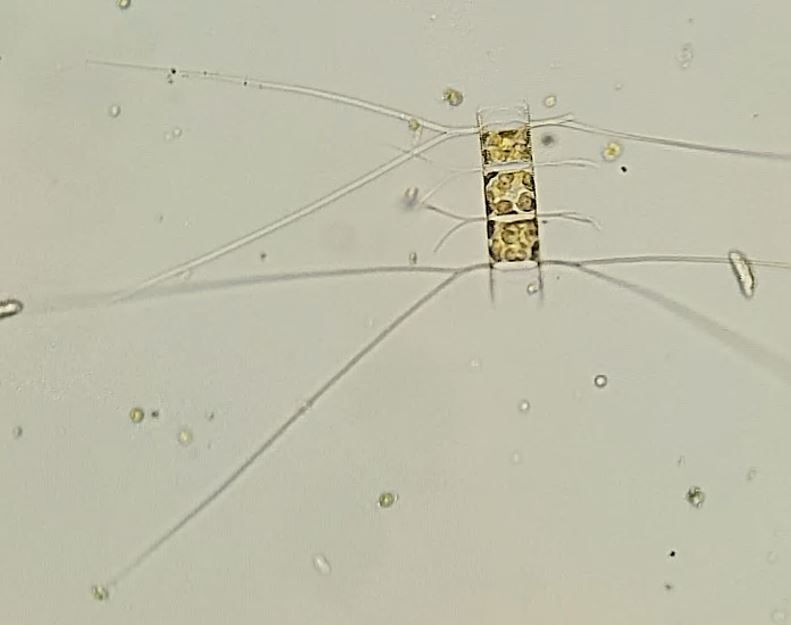

To get an idea of what the community looks like, I try to take a small subsample from as many stations as possible and have a quick look under the microscope together with Jana. This has been really exciting. Seeing phytoplankton alive is a rare treat for me, since I usually work with fixed samples. It is also fascinating to see how the community and biomass change as we move between Arctic and Atlantic influenced waters.
Jana and I will share some of our pictures in a separate post, since they deserve their own recognition, but I thought I could share a little sneak peek anyway.
All photos: Anna Narberhaus


Comments