

Phytoplankton also likes to be in a Fjord
The basins surrounding the Arctic Ocean are changing rapidly. As sea ice melts faster, primary productivity is expected to increase. Understanding how phytoplankton—the microscopic organisms at the base of the marine food web—respond to these changes is becoming increasingly important.
During the IMAGE cruise, we are following these tiny ocean dwellers very closely.
As the ship moves through the ocean, seawater is continuously collected from a depth of five metres. Every hour, a sample is analysed by a CytoSense flow cytometer, allowing us to observe and count phytoplankton with remarkable precision. Little by little, these measurements create a detailed map of phytoplankton communities across the ocean surface. We will later combine this map with ocean-colour observations from remote sensing, with an exciting objective in mind: identifying phytoplankton diversity from space.
But the surface tells only part of the story. At selected stations, we also explore deeper layers of the ocean using two CytoSense instruments. By comparing their measurements, we can validate our observations while investigating the complexity of the ocean’s vertical structure—and the different phytoplankton communities hidden within it.
The CytoSense itself is a remarkable instrument. In just 4 mL of seawater, it can count phytoplankton, from tiny cyanobacteria of 1-2 microns to long filaments and chains of diatoms of more than two hundred microns. Inside the instrument, suspended particles are separated from one another by a laminar flow and sent individually through a laser beam. As each particle crosses the laser, it produces light-scattering signals related to its size and internal structure, together with red and yellow fluorescence associated with chlorophyll and phycoerythrin pigments. In this way, every few millilitres of seawater reveal a miniature world of photosynthetic life.
Our first stations were sampled in the open waters of the Denmark Strait. There, large cells (micro-phytoplankton) were surprisingly scarce. One possible explanation is that we arrived during the late stages of a phytoplankton bloom, after the larger cells had already flourished and declined. What remained were the tiny pico- and nano-phytoplankton cells: less spectacular perhaps, but almost always present, forming a remarkably persistent background of life in the ocean.

Then the weather changed our plans.
A fresh and energetic storm swept in during the first days of the cruise. To keep both people and instruments safe, the ship sought shelter in the calmer waters of an Icelandic fjord.
And there, the phytoplankton story changed too.
Compared with the open waters of the Denmark Strait, the fjord revealed an abundance of micro-phytoplankton. Among them, we encountered many cells belonging to the genus Tripos—large and beautifully shaped dinoflagellates that stood out clearly in our measurements.

The conditions inside the fjord may help explain why they were so abundant. With plenty of nutrients and relatively little turbulence, the sheltered waters can provide favourable conditions for phytoplankton to settle and thrive. Indeed, during our two-day stay, we monitored an impressive bloom of some of the most famous late actors of the spring bloom, the dinoflagellates.
Sometimes a storm forces a scientific cruise to stop searching where it intended to look. But sometimes, that unexpected pause leads somewhere just as interesting.
Since then, the weather has become more peaceful, and we have returned to our transect, picking up our sampling almost exactly where we left off. Every hour, we continue checking the diversity of the surface waters, following the changing phytoplankton community as the ship makes its way northward.
Yet some of the most diverse—and largest—cells are not waiting for us at the surface.
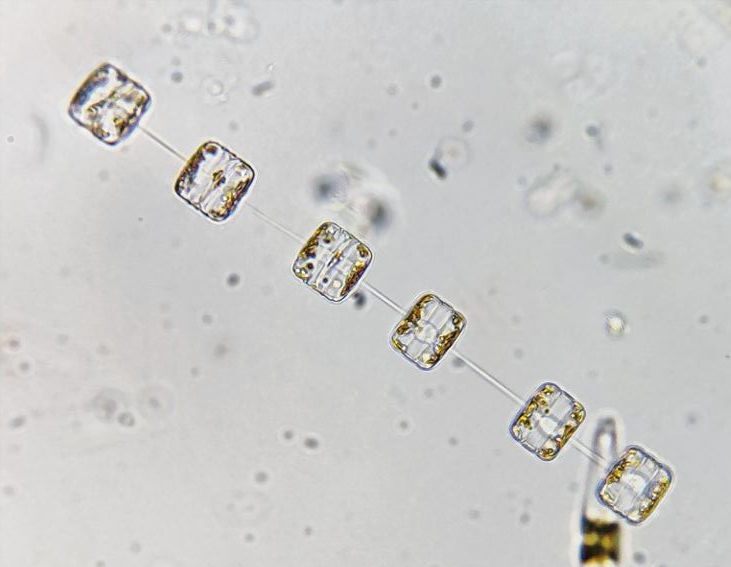
Deeper in the water column, another world appears. Here we encounter elegant, elongated Cylindrotheca, chains of Pseudo-nitzschia and Guinardia, and many other forms of diatoms. These deeper communities remind us that what we observe at the ocean surface is only one layer of a much richer and more complex ecosystem below.

For now, our tiny companions continue the journey with us—from open waters to sheltered fjords, from the surface to the deep chlorophyll maximum, and onward into the cold waters of the north.


Comments