

Odds and ends
For me, the IMAGE oceanographic cruise is filled with memorable events.
This will probably be my last major ocean expedition. Galicia X, that scorching summer of 1989 in the Ría de Arousa (Galicia), now seems far away. After nearly 40 years dedicated to oceanography, with 25 cruises under my belt and almost 2 years of my life spent living aboard a ship, the final frontier is to sail the northern seas to the gateway of the Arctic Ocean, enter the “Order of the Blue Nose,” and reach the legendary Fram Strait. IMAGE is granting me the opportunity to achieve those goals.
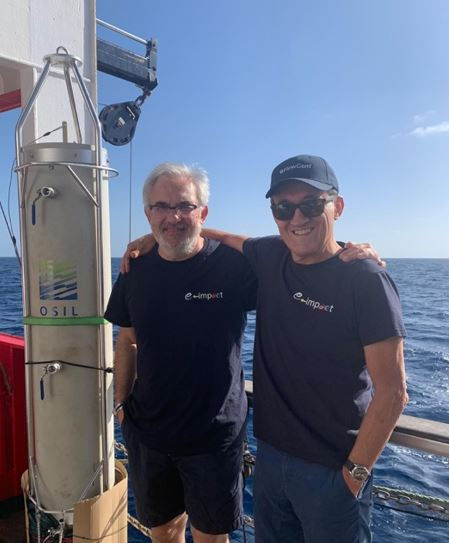
Alongside Javier Arístegui, my colleague and friend for over 30 years, we have studied how oceanographic processes modulate the biological carbon pump, which plays a key role in storing anthropogenic carbon in the ocean. This mission has led us to study the upwelling filaments of Galicia, Morocco, and Cape Verde, the extreme oligotrophy of the Mediterranean Sea, the Canary Current eddy corridor, and the Atlantic Ocean from Namibia to the Canary Islands. We conceived the IMAGE project to experience the rawness and grandeur of the northern seas. Our scientific question was clear: how does ice melt affect small-scale dynamics (1–10 km) in the Greenland Sea, and what is its impact on the biological carbon pump?

On this cruise, we are premiering the R/V Odón de Buen, the new crown jewel of Spanish oceanography. I must confess I boarded with some anxiety, not knowing the ship, but I found a highly professional crew always eager to help, making our work incredibly easy. A vital element for an enjoyable life at sea is the food, and the kitchen on the R/V Odón de Buen turns out tasty, varied, and very hearty dishes. The staff from the Marine Technology Unit (UTM) of the CSIC are making an essential contribution to the cruise's progress, assisting with every maneuver and keeping the equipment ready for deployment. And what can I say about the scientists on board? A pool of 27 people covering a wide range of ages, diverse academic backgrounds, and multiple origins. The largest contingent comes from the University of Las Palmas de Gran Canaria through the Biological Oceanography and Physical Oceanography groups. The CSIC is represented by the Institute of Marine Research, the Andalusian Institute of Earth Sciences, the Institute of Marine Sciences, and the A Coruña and Málaga oceanographic centers of the IEO. We also have the University of Lisbon (Portugal), the Technical University of Denmark (DTU), the Alfred Wegener Institute (Germany), GEOMAR (Germany), and Shanghai Ocean University (China). Many are colleagues with whom I have shared countless hours at sea, while others I am meeting for the first time. On board, you can hear Spanish, Galician, Catalan, Basque, German, and Finnish being spoken... but above all, English, the lingua franca we all share on the ship.

The Odón de Buen possesses undeniable technical capabilities and excellent living quarters, but the laboratories are small, with limited facilities for the number of scientists it can accommodate. It seems that the design prioritized comfort, which is important, over workspaces, which are equally vital. This cruise is showing us firsthand that a more efficient distribution of space would have avoided the need for container laboratories on deck, especially under polar conditions.

The IMAGE cruise has also treated us to sightings of icebergs and local wildlife, including fulmars, sperm whales, and minke whales... but above all, it has allowed us to witness a unique event in an exceptional setting: the total solar eclipse on August 12th from 71º N 21º W, aboard the R/V Odón de Buen. The eclipse reached its maximum at 17:35 GMT, lasting just over 2 minutes. Even though it was cloudy, which did not stop us from enjoying such a magnificent visual experience.


Comments