

North of 66°N
Updated: Aug 21
Finally, a quieter moment to write, slow down, and enjoy the peace and warm light of my cabin aboard the RV Odón de Buen. The very gentle rocking of the ship; the distant hum of the engine and the sound of winch operations still going on; and a night that, despite the late hour, never quite becomes completely dark at these latitudes.
I have traded the heat of the Lisbon summer for the bitter cold of the Greenland Sea, where I am now embarked for yet another oceanographic adventure: this time, the expedition IMAGE (Impact of Mesoscale Activity on Greenland SEa biogeochemistry) led by IOCAG-ULPGC (Javier Arístegui) and co-led by IIM (Pepe Salgado). We sailed from Reykjavík, Iceland, on 2 August, but only a few days later had to take shelter from a storm in an Icelandic fjord before we could resume our work. At these latitudes, bad weather is not to be taken lightly: not only it becomes challenging to operate our equipment safely, but we also really don't want to risk losing it along the way...

So far, I have only good things to say. I have a spacious cabin, with a heated private bathroom all to myself; the food is good and seems to be permanently available; and, most importantly, the atmosphere on board is friendly, relaxed and cheerful. There is always someone willing to help, and plenty of interesting knowledge to share.
But what are we actually here to do?
The overarching mission of the IMAGE expedition is to understand what controls the Biological Carbon Pump in the Greenland Sea, precisely in a region where deep-water masses form and “feed” the global ocean circulation. We are especially interested in processes occurring at relatively small timescales scales: ocean fronts, eddies and filaments. These structures can alter water-column stratification and the availability of light and nutrients to phytoplankton, influencing biological productivity and, potentially, how much carbon is ultimately exported from the surface to the deep ocean.
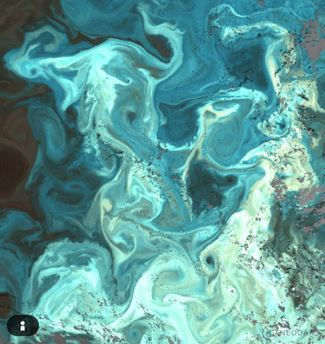
And we are in a particularly interesting place to investigate these connections. We know relatively well how important this region is for deep-water formation and for the so-called Physical Carbon Pump, but we know considerably less about the processes controlling its Biological Carbon Pump, and how the two interact. This is particularly relevant in the Arctic, which is warming much faster than the global average, with rapid changes in sea-ice cover, stratification and ocean circulation that are likely to affect both biological productivity and carbon export.
Having spent much of my career studying the tropical, subtropical and temperate Atlantic, this adventure allows me to take some of the questions that have accompanied me over the years into a completely different and rapidly changing oceanographic system.
A truly multidisciplinary team
One of the most stimulating aspects of this expedition is the diversity of the team. Some study circulation and turbulence; some measure nutrients, oxygen, respiration, pH, alkalinity, gases and isotopes; some track organic matter; some investigate bacteria; others study the abundance, physiology and diversity of phytoplankton and zooplankton; and others try to understand what happens to biogenic particles once they begin to sink.
Ultimately, each of us looks at a different piece of this complex “puzzle”, and together we try to understand the ocean as a system.
My mission: calcifying plankton
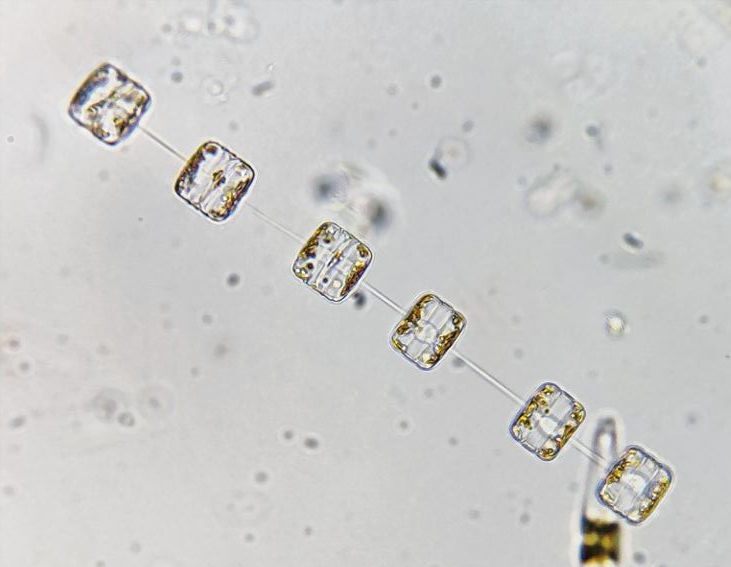
During IMAGE, I am studying the carbonate pump: the production and export of calcium carbonate (CaCO₃) by marine calcifying organisms. My usual “suspects” are coccolithophores — tiny unicellular algae covered by calcium carbonate plates called coccoliths. But this time the “family” is larger: with the help of our zooplankton ecologist Marja Koski (DTU, Denmark) and young oceanographer Paul Hanke (GEOMAR, Kiel), we are also collecting other calcifying organisms, including planktonic foraminifera and pteropods, using plankton nets.
Throughout the upper ~200 metres of the water column, I collect samples to study coccolithophores and photosynthetic pigments, which will contribute to characterise the phytoplankton and bacterial communities as a whole, in synergy with our intrepid microbiology colleagues from MIO (Melilotus Thyssen), IOCAG-ULPGC (Javier Arístegui, Nandy Monteiro and Nauzet Hernández), IEO-CSIC (Massimo Pernice) and AWI (Anna Narberhaus).

But I want to know not only who lives at the surface, but also who is sinking. So, in collaboration with our biogeochemists from IIM (Pepe Salgado and Vanesa Viéitez), we are using a Marine Snow Catcher: a kind of giant oceanographic bottle that collects around 100 litres of seawater below the chlorophyll maximum. We then allow the particles to settle and separate them according to their sinking velocity. Our aim is to determine which coccolithophores and carbonate particles manage to escape the productive layer and continue their journey into the deep ocean — and to what extent CaCO₃ from the coccoliths can act as ballast, helping organic-rich aggregates sink faster.

Life at sea
But an oceanographic expedition is never just about science. One of the things I love most about being at sea — and this is now my 14th scientific cruise— is precisely this: knowing that I am in the middle of the ocean, removed from the “real life” of everyday routines, and simply present and available for the mission ahead of us over the coming weeks.
I am usually used to much smaller cabins than the “palace” I have been given this time. Sometimes little more than a bunk beneath a low ceiling as when I went to Antarctica in 2019 aboard the Brazilian polar vessel Almirante Maximiano ((I still remember the countless times I hit my head!). Here, aboard the majestic Odón de Buen, I even have the luxury of warming my bath towel in my own private bathroom, brand new and waiting for me when I arrived. :)
Being at sea... it is difficult to explain why, but it always does me good. It may not happen immediately. The first few days are often still a bit tense and full of adjustments: making sure everything is ready for sampling to begin, adapting to an entirely new routine, different schedules and food, constant social interaction, and even a kind of tiredness that stubbornly settles into your bones while you are still getting used to being here. But as the days went by, my body and mind eventually found their own little “existential corner” in this small, multi- and transcultural floating country called Odón de Buen.
Science, codfish, languages and Portuguese towels
It is impossible to be surrounded by so many scientific experts and resist bombarding them with questions and ideas. Conversations jump from physical oceanography to biogeochemistry, from plankton to alcalinity, pH and climate, and a few people are also curious to understand how a micropalaeontologist like me ended up following scientific paths so strongly shaped by biological oceanography, biogeochemistry and atmosphere–ocean interactions.
Alongside the scientific conversations, of course, there are the typical conversations of international marine expeditions; if I had to choose a Top 5 of the most recurring topics on board, they would certainly include the historical, cultural and linguistic richness and complexity of Spain; the typical — and favourite — foods and drinks from each of our countries; politics and the social changes currently unfolding across the western world; our very different musical tastes during the long hours spent filtering samples in the wet lab; and, inevitably, the ideas, curiosities and stereotypes we all bring with us about each other's countries.
It has been particularly amusing to discover Portugal through the eyes of my fellow travellers. Our collective obsession with codfish is apparently very well known; Portuguese wine has an excellent reputation; there is some surprise that a country with so much ocean (and so much maritime history!) does not invest more heavily in ocean research; fado remains associated with our supposed melancholy; and apparently, we are quite good at learning foreign languages. And I discovered something about Portugal that I did not know: according to our “Iberian and Canary Island neighbours”companions, we are a great country in which to buy good-quality towels at a reasonable price (...?...) :D
Another nice impression from previous encounters has also been confirmed: a certain affection that Galicians — of whom there are many on board — seem to have for Portugal. There is a linguistic, historical, cultural and even emotional closeness between the two peoples.
Sailing north of the Arctic Circle
For now, apart from a few relatively distant and occasional icebergs, the landscape around me still does not feel all that different from the Atlantic I am used to. That is why I am looking forward to reaching the final transect of the expedition, in the Fram Strait, at around 80°N.
There, I hope finally to encounter the frozen landscape that fills our collective imagination as we picture ourselves approaching the North Pole. Stay tuned for moore updates from our team!


Comments