

Miraculous Metridia and other fantastic critters from below the surface
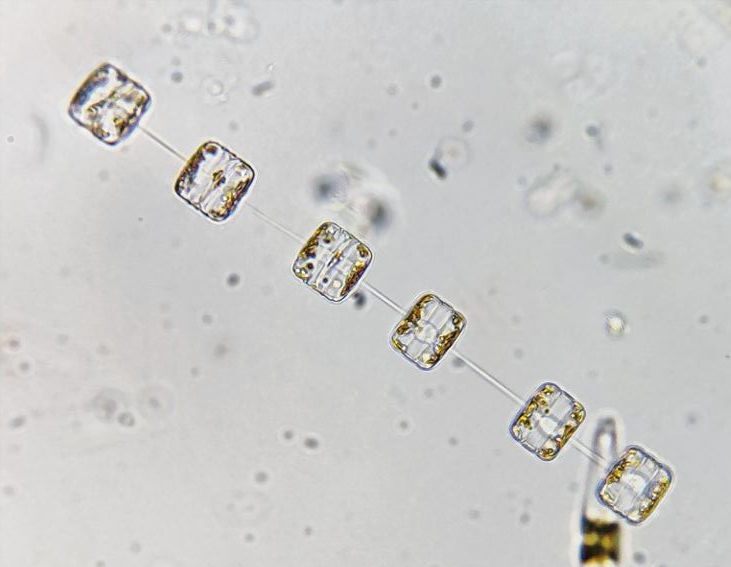
We don’t often think about life below the surface, unless it is about whales, sharks, tuna or other large or edible creatures. However, most of these would not exist if there were no zooplankton: The millimeter-sized crustaceans and jellies with their amazing adaptations to the life in the ocean. In the Arctic the most spectacular one is the copepod Metridia, a little critter which flashes a bright blue light when disturbed, apparently to confuse predators. The same copepod performs daily vertical migrations of several hundred meters, coming up to the surface to feed at night and descending to darker waters during the day, to avoid being eaten by fish that use eyesight to find their prey. A remarkable achievement for an animal of a few millimeters, and particularly since water for these small creatures is a viscous environment demanding constant muscle power to move – like it would be for us to swim in a syrup. This miraculous Metridia and its similarly fascinating relatives can be seen in our net samples and under a microscope onboard Odon – an amazing show of biodiversity that we do not expect to encounter when looking at the monotonous surface of the ocean.
Multinet being deployed in the Greenland Sea (Photo: Javier Arístegui), and a look at the microscope view of a group of copepods (Photo: Jana Piñel). The copepods are red because of a stain (Neutral Red) that is used to distinguish live copepods (colored red) from the dead ones (no color). This is to quantify the number of copepod carcasses that are also an important source of carbon to the depth.
Besides being fascinating in their own right, zooplankton plays a central part in two ecosystem services that we humans depend on: Fisheries and carbon export through the biological pump. Zooplankton feed on phytoplankton, the microscopic primary producers, and are in turn food for the fish. In fact, most of the commercially harvested fish feed on zooplankton in some stage of their life, so no zooplankton – no fish. But zooplankton – and particularly copepods – are also extremely important for the carbon export because they influence the efficiency of the biological pump. Depending on the types of the copepods (their functional group), they can either enhance the efficiency of the biological pump or decrease it. In short, large (in copepod-scale) phytoplankton-feeding copepods, such as Metridia and Calanus, perform daily and seasonal vertical migrations, re-package part of their food into dense fast sinking fecal pellets (yes, we are talking about copepod feces here) and respire while at deeper waters, and while doing these things actively transport carbon from the surface ocean to the depth. In contrast, several small species specialize in feeding of sinking particles – fecal pellets and aggregations of phytoplankton and other stuff – and while doing this recirculate the carbon in the surface ocean and therefore reduce the export. The question is what are the consequences if these small copepods increase at the expense of the large ones, as has been suggested to be the case in our warming ocean, and is this likely to happen? In Odon we investigate this question by collecting samples for zooplankton abundance and biomass at different depths, counting the daily fecal pellet production of dominant species (yes, believe it or not, feces counts are a cornerstone of copepodology), and measuring the carbon to nitrogen ratio of copepods, their food and their pellets. Relating these to environmental conditions will hopefully help us to understand if and how the functional composition of zooplankton and its effect on the biological carbon pump might change in the future Arctic.
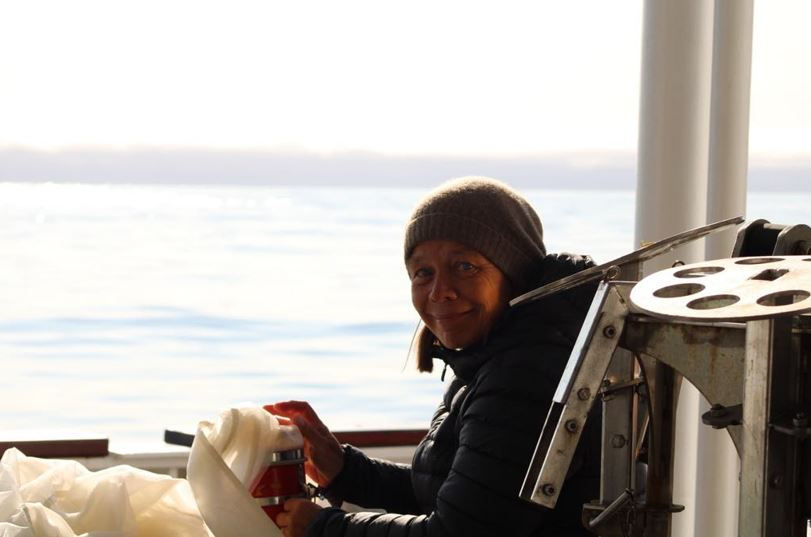
Scientific cruises are always exciting. The other day we talked about the fantastic photos that we tend to show students, colleagues, friends and family when we return: The whale, the sun set, the northern lights and so on. Typically, I do not show so many photos of the > 300 Petri-dishes with copepod fecal pellets that I counted, or the 30th deployment of multinet, although most of the time onboard goes on these (might be wise not to, considering that oceanography students are at short supply). However, apart from the exciting activities on the copepod front, there has also been a little time left for other things, like learning Spanish – or at least trying to. I’ve made some progress (which is not so difficult when the starting point is zero), although with a few hick-ups. Like, when I wanted to ask the bosun if he was tired (¿Estás cansado?) but came to ask him – and likely a lot of other people too – if he is married (¿Estás casado?). Communication is the key, or at least that’s what they say… The marital status of the people onboard is thus well established (or they were tired – I cannot tell). But mañana será otro día with new net deployments and Petri-dishes full of – well, you know by now. Jippiajay – it’s bound to be an adventure day!


Comments