

Reading the isotopic fingerprints of the Artic water
Looking at the sea from the deck, it is impossible to know where the water beneath us has come from. Some of it has travelled northward from the Atlantic; some has arrived from the Arctic, while another fraction may ultimately derive from precipitation, melting sea ice or the Greenland Ice Sheet. Yet these different histories leave chemical fingerprints in the water.
In a way, the global water cycle behaves like a gigantic natural still. Water evaporates from the ocean and, as atmospheric moisture is transported towards colder and higher latitudes, it repeatedly condenses and precipitates along the way. At each step, the
heavier water molecules containing 18O and 2H are preferentially removed (δ values are more negative), leaving the remaining moisture progressively depleted in these heavy isotopes (Fig. 1). By the time snow falls over the interior of Greenland, its isotopic composition is therefore very different from that of the ocean from which the water originally evaporated.


Over hundreds of thousands of years, part of this isotopically light water has been stored in the Greenland Ice Sheet. Today, when ice melts and freshwater reaches the surrounding ocean, it carries this distinctive isotopic fingerprint with it (Fig. 2).
This makes δ18O and δ2H powerful natural tracers, allowing us to identify freshwater inputs and better understand how Arctic, Atlantic and Greenland-derived waters mix at this remarkable oceanographic crossroads.
Salinity, together with δ¹⁸O and δ²H values, is key to investigating these water-mass mixtures (Fig. 3).
This matters because freshwater is not just another component of seawater. By lowering salinity, it changes seawater density and stratification, properties that influence how readily surface waters mix and participate in the large-scale circulation of the North Atlantic.
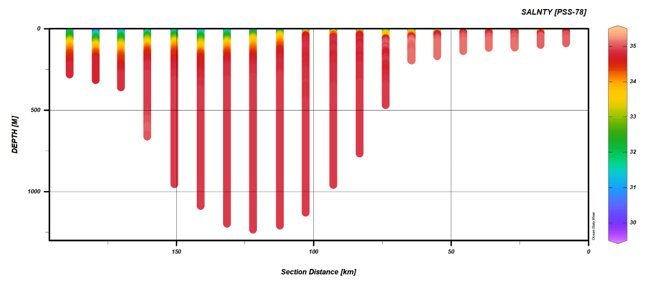
At each station of the IMAGE transect, we therefore collect more than just bottles of seawater. We are sampling different pieces of the history connecting the Arctic, Greenland and the North Atlantic.
This freshwater input has implications that extend well beyond the waters surrounding Greenland. The Atlantic Meridional Overturning Circulation (AMOC), which transports heat northward and returns cold, dense waters southward at depth, is projected to weaken as the climate warms, although the magnitude and timing of this change (and particularly the possibility of an abrupt collapse) remain actively debated. Freshwater entering the North Atlantic can alter salinity, density and stratification, potentially affecting the processes involved in deep-water formation and circulation. Understanding where this freshwater comes from, how much is present and where it goes is therefore an important piece of a much larger climate puzzle.
Our measurements do not monitor the AMOC itself, but they help characterize freshwater inputs and mixing processes that can influence this complex circulation system.
Isotopes provide one piece of this broader picture. Combined with physical oceanography and biological observations made by the other teams on board, they help us understand how water masses, biogeochemical cycles and marine ecosystems interact at this Arctic-Atlantic crossroads.


The structure of this article makes it fairly convenient to understand the topic. The introduction gives some useful context, while the later sections provide more specific information. I noticed that Singam Lottery was discussed naturally within the main content rather than being treated as the only subject of every paragraph. The writing remains fairly balanced throughout. Overall, this is a useful read for anyone who wants a general overview of the topic.