
Biological Oceanography
in a Changing Ocean
News & Events
Exploring the Nordic Seas
July 15, 2026
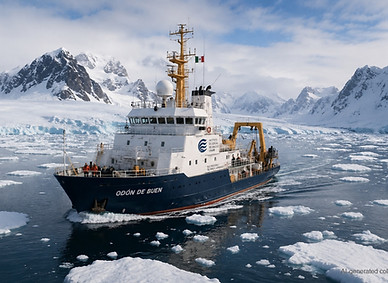
This summer, abroad the RV Odón de Buen, our team will sail from the Denmark Strait to the Fram Strait, following the East Greenland Current as part of the IMAGE project. Along the way, we will investigate how ocean currents, melting sea ice, and swirling ocean features shape life beneth the surface.
By studying how these processes transport and transform organic carbon, we aim to better understand the Biological Carbon Pump - one of the ocean's natural mechanisms for capturing and storing carbon from the atmosphere.
The Nordic Seas connect the Atlantic and Arctic Oceans and play a pivotal role in regulating Earth's climate. Every new observation helps us better understand how our changing oceans influence the global carbon cycle.
Find more about the project here.
We welcome Dr. Solange Duhamel to our research group
March 16, 2026

As a distinguished 2025 Fullbright Scholar from the University of Arizona, Dr. Solange Duhamel is bringing her world-class expertise to the University of Las Palmas de Gran Canaria. Her research is at a cutting edge of oceanography, focusing on the critical role of phosphorus cycling. By studying how this essential nutrient moves through the sea, her work helps us better understand the mechanisms that sustain marine ecosystems and global ocean health.
Beyond her pioneering research, Dr. Duhamel is also making a significant impact in the classroom. She is currently sharing her knowledge with the next generation of scientists, teaching specialized classes to both Bachelor's and Master's degree students. We are honored to have her collaborating and look forward to the insights her stay will bring to our academic community!
More here
Attending the Ocean Sciences Meeting 2026
February 22 - 27, 2026

Our team - Yeray, Nauzet and Aja - attended the Ocean Sciences Meeting (OSM) 2026. This meeting was held from February 22 to 27 in Glasgow, Scotland, and hosted more than 6000 researchers from around the world. Together with external colleagues, Yeray and Nauzet put on different types of sessions to "Unravel Physical-Biological Interactions at Meso- and Submesoscales”. Nauzet also participated in the session on “Respiration in the Mesopelagic Ocean: Reconciling Ecological, Biogeochemical, and Model Estimates”, while Aja presented her work in the session on “Aerosol Deposition in the Ocean: Sources, Drivers, and Biogeochemical Effects”.
Their research contributed to constructive dialogue and knowledge exchange among fellow scientists, prompting future collaboration.
More on the event here.
New paper on meso- and submesoscale variability of organic matter in island-induced eddies
February 18, 2026

This study reveals how the “Canary Eddy Corridor” acts as a massive, natural engine for the ocean’s biological carbo pump. Using high-resolution sampling, we tracked four ocean eddies south of the Canary Islands to see how they transport and transform organic matter.
We observed a dynamic two-way pump system; while recently formed cyclonic eddies like “Garajonay”, act as a nutrient-rich hotspot for phytoplankton blooms, anticyclonic eddies like “Bentayga” steadily accumulate organic matter and extend toward the open ocean.
Up to 88% of the oxygen demand in the twilight zone is driven by the local breakdown of dissolved and suspended organic carbon trapped within the eddies. The study underscores the importance of the Canary Eddy Corridor as a vital regulator of global carbon storage and marine life survival.
Read the paper here.
Unveiling the Mystery of Respiration in the Dark Ocean
February 05, 2026

Together with colleagues from the Scientific Committee on Ocean Research (SCOR) working group “Respiration in the Mesopelagic Ocean (ReMo)”, we set out to unravel the mystery of respiration in the dark ocean. Our work was published in Frontiers for Young Minds, a unique scientific journal in which articles are reviewed by a board of kids and teenagers.
This innovative approach to science—designed to be accessible particularly to young readers—explores the wonders of the mesopelagic zone (200–1000 m depth), where darkness replaces sunlight, temperatures drop close to 0 °C, and pressure makes life seem almost impossible. Yet, this zone is teeming with life.
More on the publication here.